Showing posts with label art. Show all posts

31 July 2013

A Clipper Sails West


Aye, she was a bonny lass and when she set off, sails unfurled and wind-filled, a sigh escaped my lips; I would see her perhaps nevermore.

Which is a fanciful and literary-sounding way of saying, one of my typewriters moved on to another home.  Even better, however, in this transfer, a new Typospherian was born!

Friend and Colleague in all things mad and wonderful, Hoja, visited this weekend.  We call these get-togethers our Art Days. Some days art is made; some days we look at formal art; some days we talk story making and world building; and some days we simply play.  This weekend we did it all! 

A visit to see the 30 Americans exhibit at the Milwaukee Art Museum. It was rich, complex, sobering, and deeply moving. 


 Milwaukee Art Museum, Quadracci Pavilion, 2002. Credit: John Hursley.


(Left) Nick Cave, Soundsuit 
(Right) Iona Rozeal Brown, Sacrifice #2: it has to last
(after Yoshitoshi's 'Drowsy: the appearance of a harlot of the Meiji era')

[from the MAM 30 Americans Exhibition Gallery]


We also drove North to visit the John Michael Kohler Arts Center; located in Sheboygan, WI. There were two large installation pieces that had the both of us laughing, sighing, and looking so very interested that the museum guard kept a very close eye. We signaled that we would not touch by keeping our hands in our pockets or behind our backs (but, ooooh, we so wanted to touch the works!).

One exhibit, titled Emery Blagdon: The Healing Machine, filled a large room. 


 Installation view of Emery Blagdon: The Healing Machine at the John Michael Kohler Arts Center.
(All images courtesy John Michael Kohler Arts Center, Sheboygan, Wisconsin)


Emery Blagdon, “The Healing Machine”
(installation view John Michael Kohler Arts Center, 2012) (detail),
(c.1955 – 1986), dimensions variable. John Michael Kohler Arts Center Collection.

[From the exhibition website]

"Emery Oliver Blagdon (1907-1986) grew up on the Sandhills of Nebraska. The intense lightning storms of the Great Plains were a source of wonder for Blagdon, who pondered the immense power of lightning and other natural energies.

In 1955, Blagdon inherited an uncle’s farm and found he had a place to explore his interests as he chose. Having watched both his parents suffer terminal cancer, he hoped he might discover a way to heal pain and illness. Blagdon believed that the earth’s energies might be put to just such a use. He believed they held the inherent power to heal, and he set about making a “machine” to properly channel these powerful forces.

A pastime of bending hay-baling wire into geometric forms grew into a consuming passion for making increasingly complex constructions that incorporated salvaged copper wire, metal foil, magnets, vials of earth, waxed paper, and myriad other substances and materials to collectively charge and heighten the machine’s power. In the early 1960s, Blagdon began installing his fabrications in a barn on the property, later building a workshop with an adjoining shed designed to permanently house the entire machine.

Blagdon ultimately created a complex art environment in which paintings and mixed-media sculptures comingled with mineral elements and electrical conductors. Sufferers of pain or illness were invited in to let the unseen forces work magic. Blagdon called his project The Healing Machine, a work in constant progress wherein he fashioned, arranged, adjusted, and added to the complex installation every day for the next thirty years.

Blagdon’s Healing Machine, comprised of roughly 400 individual elements, is part of the John Michael Kohler Arts Center collection. This exhibition presents individual components as well as an installation evoking the original shed environment."

(John Yau has written an expressive review of the exhibit. You can read it here.)


~ * ~ * ~ * ~ * ~ * ~

The second piece -- Rush to Rest, by New York artists Wade Kavanaugh and Stephen B. Nguyen -- was massive and filled the two largest gallery rooms of the museum.  


A near life-long resident of Wisconsin, one of my keenest pleasures has been to see the wintertime ice formations along the Lake Michigan coastline.  Kavanaugh & Nguyen captured not just the vibrancy of the shapes but the deep emotional qualities of frozen movement.  The image above simply cannot capture the grandeur of the work.


[From the exhibition website] Artists Wade Kavanaugh and Stephen B. Nguyen (NY) discuss their new work, Rush to Rest, part of the Uncommon Ground exhibition series at the John Michael Kohler Arts Center, Sheboygan, Wisconsin, April 12–September 22, 2013. Video produced by the John Michael Kohler Arts Center.

[From the exhibition website] "Rush to Rest, by New York artists Wade Kavanaugh and Stephen B. Nguyen, is a response to the colossal seasonal ice sheets that take shape on the Sheboygan lakefront in winter. This immersive installation is not a literal rendering of the accumulated ice pack but rather an aggregate of its physical characteristics. Rush to Rest exaggerates the mass and color of the frozen expanse as well as the tangible manifestations of wind and water that generate it."

NOTE: When "Rush to Rest" closes Sept. 23, the exhibit will be dismantled and recycled.

In the evening, back at home, there was talk of typewriters.  Several times over the past few years I have offered a machine to Hoja.  This time she took me up on the offer and asked if she could try out several to get a feeling for their "personalities."  So I laid out several on the dining room table for her to test drive.


The Skyriter (bottom, lower right) was not part of the offer, but I wanted her to try that one as most of my friends who spend most of their time on computer keyboards find it the easiest to type on initially.


In the end, she decided on the Smith Corona Clipper.  I was able to locate a near-era user's manual for it in my typewriterly stash, and also threw in a learn-to-type book and new ribbon.  


As you can see, Hoja was delighted!


 We welcome her to The Typosphere!


09 April 2013

VIDEO: Rembrandt's Night Watch via Flashmob


[UPDATE: CNN has posted a nice little interactive that explains this painting a bit more.]

Many thanks to Artist/Author James Gurney for highlighting this truly amusing and entertaining video today. Be sure to compare the image above with the final cast picture at the end!
"The slogan 'Our Heroes are Back' is used to announce that, after an absence of one decade, all major pieces in the Rijksmuseum's collection are back where they belong. This is what happens when they suddenly emerge in an unsuspecting shopping mall somewhere in The Netherlands. With the support of main sponsor ING, entrance to the museum is free on the 13th of April from 12:00 to 00:00.

"This Flashmob recreates Rembrandt's Night Watch. It's considered one of the most famous paintings in the world
."
[from the YouTube description]


10 February 2012

A Few More Encouraging Words


The spelling of the author's name (Vonnegut) is wrong, 
but the sentiment is straight on!


25 January 2012

A Posting of Positive Posters


Main Reading Room, 
Thomas Jefferson Building, 
Library of Congress. 
Learn more about this and other historic areas 
of the Library of Congress by visiting 
 
Who knew? The Library of Congress has a Flickr photostream of 25 posters from their Work Projects Administration Poster Collection.  Here are just a few (clicking on any one of them will take you the LoC Flickr posters).

National letter writing week, Oct. 1-7 (LOC)

See America (LOC)

Visit the zoo (LOC)


Be careful near machinery (LOC)

The vacation reading club - join now at your public library (LOC)

FYI: The Library of Congress Flickr account contains 14,744 images to date!  Check it out here.


19 November 2011

Painters Who Echo


Even though I have something of a struggle with the philosophy of the realist style, I am drawn to its clarity of line and color.  Recently artist James Gurney was one of the jurors for Plein Air Magazine's Salon competition.  He featured a few of the winning paintings on his website.  One that caught my eye was by artist John Ball.


Before I read Gurney's comments, I thought "Oh, John Singer Sargent"  I guess I know more about art than I think I do for Gurney had the same observation! I didn't know Sargent was in the Realist camp.  I thought Realism favored a more precise rendition of things, an almost photographic recreation.  But looking at Ball's work, and Gurney's in comparison with Sargent, I am getting a better idea of what this style really is.

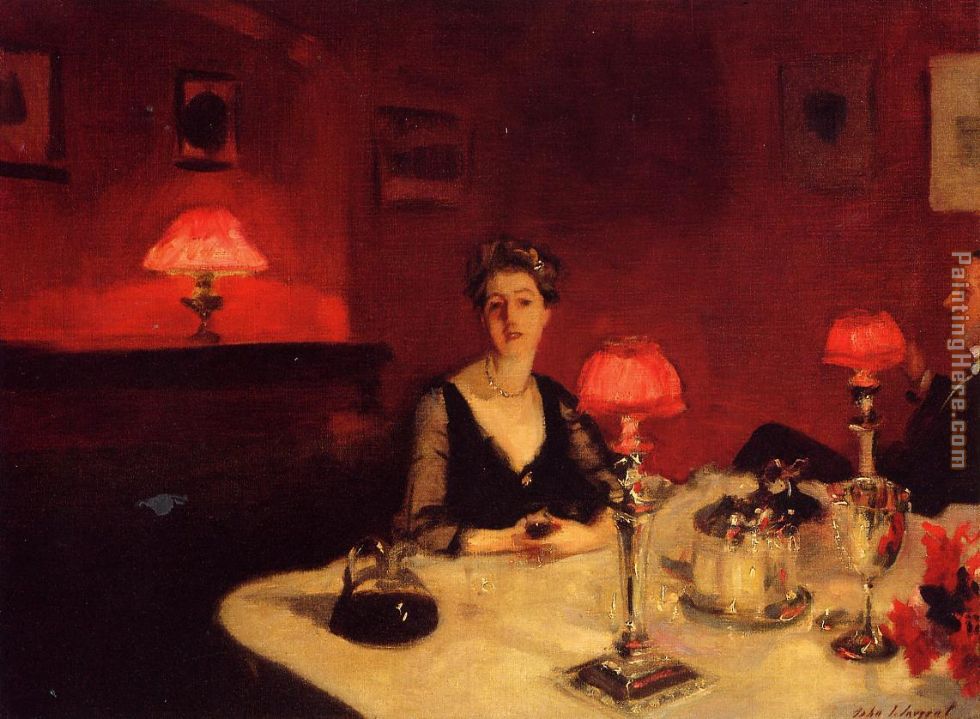
A Dinner Table at Night
by John Singer Sargent

Here is another pairing of Ball and Sargent which show a shared sense of light and color.

A Prelude to the Day
by John Ball

The Oyster Gatherers of Cancale 1878
by John Singer Sargent

And two more, this time portraiture.  I so much enjoy the blend of direct color and subtle movement of light that both artists employ.

Moving into Evening
by John Ball

Spanish Dancer
by John Singer Sargent

Mr. Ball's biography can be found here.  A good history of Mr. Sargent is here.

19 October 2011

An Artist on Art Making


 Artist James Gurney (and friend)
Story of this pic is on his blog here.

Early in 2011 I "hearted" artist James Gurney, painter in the Realist style and author/illustrator of the much beloved Dinotopia books.  I referred to him then as Mr. Whimsy because of his delightful sense of humor and truly childlike joy.  But Mr. Gurney is a serious artist and, fortunately for us, a darn good teacher about what he does.

"Bilgewater"
by James Gurney, in his book Journey to Chandara

"Journal"
by James Gurney, in his book Journey to Chandara

These past few weeks he's had a series of posts on his blog about his one-time work as an illustrator for the movie studio of Ralph Bakshi Productions. Here's the link the to last one which includes the link to the others in the series. This is really splendid stuff. 

 A younger Gurney (left) at work on a background painting.

He talks about the process of making, the camaraderie and often wild antics of his studio mates, and the sense of film making history.  As I said, splendid stuff - read it!

Links to Mr. Gurney's various sites:

His artist website
His blog
The Dinotopia website


21 March 2011

Versions of Things Beloved, Part 1

About this globe - see note at end of post

Everyone has their favorite books. The Dispossessed by American author Ursula K. Le Guin is one of mine. I read it for the first time the year after it was published (1974). Since then I have read it at least once a year. How I read it varies considerably. Sometimes I read it straight through from start to finish. Other times I read only the chapters set on the planet Anarres. Often I just open the book randomly and read a few pages. 


Several aspects of the book appeal to me. The complexity of the world building by Le Guin is profoundly attractive. This includes the physical worlds, their cities, their climates, and their flora and fauna. It's not a matter of how well she visualizes things for her reader. It goes deeper than that. Although Le Guin's world building is framed by the socio-political context of the 1960s and 70s, she manages to create a place with a solid and unique sense of its own reality. 


The cultures of the two worlds (Anarres and Urras) are deliberately set in conflict with each other, but each culture stands on its own in terms of its psychology, sociology, customs, and ways of being. As a one-time theater major and long time imagineer I am always captivated by how culture(s) manifest and make of themselves. Much of my time reading the book involves my imagination crawling around Anarres mostly, but also Urras, trying to see how the buildings are built, the clothing designed and made, the food recipes preferred, and the people interacting.


The quality of psychological differentiation possessed by several key characters from Anarres is something I find very satisfying. I like, too, that the major characters (Shevek, Takver, and Bedap) are comfortably intellectual while also plainly social and creative. It is unusual, however. In a 1990 short story "The Shobies' Story," Le Guin created a decidedly less savory character who is identified as being from Anarres.


Finally, I am intrigued by the utopian discourse that underlies the story and its characters. This book always strikes me as an imagination in motion - even though the story is long since published, the events set, and the politics gnawed to death by reviewer after reviewer. Le Guin wrote The Dispossessed as a deliberate thought exercise. I find myself continuously drawn to and curious about how writers create. And Le Guin is a master writer.

Other people's thoughts on the work:
Study Guide for Ursula LeGuin: The Dispossessed (1974)
This guide was prepared by Professor Paul Brians of Washington State University. It's one of the more detailed and thoughtful takes on The Dispossessed I've seen. 
A review of The Dispossesed by Victoria Strauss (2000).
I have my own personal and literary take on the book. It's always interesting to read someone else's perspective. This review focuses pretty much on the plot and politics alone. (Missing is a sense of the characters as people and the two very detailed cultures Le Guin has created.)


BOOK: The New Utopian Politics of Ursula K. Le Guin's The Dispossessed. Edited by Laurence Davis and Peter G. Stillman. Lexington Books, 2005. ISBN: 978-0739110867

This is a thoughtful set of essays ending with a short piece by Ms. Le Guin herself. She liked this book, saying: "This is criticism as I first knew it, serious, responsive, and jargon-free." The book is erudite and scholarly. An interesting read but one that also demonstrates how scholars can sometimes kill the underlying joy of a story by focusing at length on its meaning.


BOOK:  Political Theory, Science Fiction, and Utopian Literature: Ursula K. Le Guin and The Dispossessed. By Tony Burns.  Lexington Books, 2010. ISBN: 978-0739122839

I haven't read this yet so I cannot comment.  But here's the blurb from Amazon: "This work challenges both the widely accepted view that 'The Dispossessed' represents a new kind of literary utopia and the place of Ursula K. Le Guin's novel in the histories of utopian/dystopian literature and science fiction."

NOTE:  The Making of the Anarres Globe

As this book has so long been central to my life, I wanted to create some thing that would give me a personal, physical connection to this imaginary place.  Having once made for a friend an elaborate ink and colored pencil map of his much cherished fictional world - Anne McCaffrey's Pern -- I set about creating a map of Anarres.  But it never seemed sufficiently real.

I took my sketches and ideas to my brother, Architect, and asked him if he could help me work up a 3D sketch.  He came up with a schematic using an image he'd found online (and included above in this post).   But I still struggled to make the map.  Meanwhile, unbeknownst to me, Architect had contacted two other siblings, WoodCrafter and Artist; and the three of them conspired to make my planet for me.

Architect created the master plan.


WoodCrafter found the materials (wood and metal) 
and created the sphere, base, and globe carriage. 


And Artist, using her considerable skills with paint, line, 
and stagecraft, painted the map onto the now 3D surface. 


It was -- is -- a truly astounding gift and a profoundly well-imagined and well-crafted work of art. It is perfect.  It looks like an artifact from Anarres - not like a cardboard globe one buys at map stores.  It looks like something the book's main character, Shevek, might have in his workplace or that might be found at one of the children's learning centers.  It is a deeply made thing


Related Posts Plugin for WordPress, Blogger...