Showing posts with label fiction. Show all posts

17 December 2018

Opening Lines


Once upon a time text written by pencil

I have to think that the opening sentence of a story or essay is the hardest of all to write. When I taught Freshman Composition, I would remind my students not to get too hung up on their first line. I'd tell them to write something, anything, and just get on with it. One could always come back later. Indeed, later often proved to be the only way to get that first sentence to work--after all the rest of the writing had been done. One finally had context. The ending of things, as it were, provided the beginning.

Black man wearing glasses reading a book

The same is often true in academic writing when trying to write an introduction. One wants it to be snappy, intriguing: you want it to grab the reader's attention. I was told, and have often read this same advice from others, to leave off writing one's introduction until the end. A Google search on purpose of introduction provides a plethora of advice, most of it rather dry, though all stating pretty much the same thing: "The purpose of the introduction is to orient your reader and create interest in the paper." [Source]

Opening lines in fiction, while sharing the same goal of capturing the reader, require stronger stuff.

An illustration from Herman Melville's Moby-Dick
"Call me Ishmael" (Herman Melville, Moby Dick, 1851)


”It was the best of times, it was the worst of times, it was the age of wisdom, it was the age of foolishness, it was the epoch of belief, it was the epoch of incredulity, it was the season of Light, it was the season of Darkness, it was the spring of hope, it was the winter of despair.” (Charles Dickens, A Tale of Two Cities, 1859)

"I had the story, bit by bit, from various people, and, as generally happens in such cases, each time it was a different story." (Edith Wharton, Ethan Frome, 1911)

"It was a pleasure to burn." (Ray Bradbury, Fahrenheit 451, 1953)

”We were somewhere around Barstow on the edge of the desert when the drugs began to take hold.” (Hunter S. Thompson, Fear and Loathing in Las Vegas, 1971)

 
Now, after teaching writing for so many years, I find myself in the position of my many students: stuck at the beginning, waiting for that first perfect sentence. In my case, I am trying to use the sentence as a lever; not to open the story--I have the plot well in hand--but to get at the overall approach of the storytelling itself. 

I am working on a science fiction novel, which may be the issue. The mystery novel I am also working on seems to be able to write itself. The mystery genre has its expected structure and characters. The folks at Scholastic Professional Books have posted a teacher's instructional/help guide, "Genre Characteristics Chart." About the mystery genre it states:
"Usually involves a mysterious death or a crime to be solved. In a closed circle of suspects, each suspect must have a credible motive and a reasonable opportunity for committing the crime. The central character must be a detective who eventually solves the mystery by logical deduction from facts fairly presented to the reader. This classic structure is the basis for hundreds of variations on the form."

My variation has two central character detectives, one a Map Librarian and the other a female Chief of Campus Police. It is an academic mystery. (They say to write what you know and this is so much my world that the world building is a snap though the story itself and the characters and their development are as challenging to write as any other kind of good writing.)

Science fiction writing, for me at least, is a whole other kettle of extraterrestrial fish. As with the mystery, I've already worked out the basic plot. (For the mystery I've actually written the last scene of the fifth and final book of the series which is rather cheeky of me since Book 1 has yet to be written!) But really good SF wants new worlds and, to my mind, something a little more in the presentation. 

Sheri S. Tepper (1929-2016) had the knack of dropping her readers in the middle of it all. You are forced to sort things out as you go. After Long Silence and Grass are good examples of this. The settings are just familiar enough to lull you into thinking you know where she is headed but the setting shifts and the plot refuses to play along with your expectations.
 
Grass coverAfter Long Silence cover

Ada Palmer's Terra Ignota series grabs you by the scruff of your readerly neck and pulls you along rather whether you like it or not! Her setting is our own Earth but, while the geography and language are all familiar, her future history is a splendid, mind-breaking (in my case) assault on what our current history transformed into. 


Too Like the Lightning coverSeven Surrenders coverThe WIll to Battle cover


I confess I am still working my way through these, struggling really (and she is still writing the final novel of the set). As an aspiring SF writer I find her description of herself and her approach profoundly useful, however. Here's what Palmer says of herself on the About page from her website: "All my projects stem from my overall interest in the relationship between ideas and historical change. Our fundamental convictions about what is true evolve over time, so different human peoples in different times and places have, from their own perspectives, lived in radically different worlds with radically different rules."

That kind of rigorous grasp of vision is what I am aiming for--and is why I am struggling with how to approach the opening of my novel. Is it a straight out chronological narrative? A collection of miscellaneous science reports, character letters and/or journal entries, and vignettes a la Le Guin's Always Coming Home? 

No answers to report just yet. For now I am simply grabbing various books off my shelves and reading the first few pages just to see how various writers are doing things:

"The Western plains of New South Wales are grasslands. Their vast expance flows for many hundreds of miles beyond the Lachlan and Murrumbidgee rivers until the desert takes over and sweeps inland to the dead heart of the continent." (Jill Ker Conway, The Road from Coorain, 1989).

"How the patient scientist feels when the shapeless tussocks and vague ditches under the thistles and scrub begin to take shape and come clear: this was the outer rampart--this the gateway--that was the granary! We'll dig here, and here, and after that I want to look at that lumpy bit on the slope. . . ." (Ursula K. Le Guin, Always Coming Home, 1985)

"This is written from memory, unfortunately. If I could have brought with me the material I so carefully prepared, this would be a very different story. Whole books full of notes, carefully copied records, firsthand descriptions, and the pictures--that's the worse loss. We had some bird's-eyes of the cites and parks; a lot of lovely views of streets, of buildings, outside and in, and some of those gorgeous gardens, and, most important of all, of the women themselves." (Charlotte Perkins Gillman, Herland, 1915)


Right now, landscapes seem to be what I need. I'll see where this takes me!


_____________________________________________________


* For more on Palmer's approach, see this panel discussion transcript: "Fiction and History: Narratives, Contexts and Imagination", by Ada Palmer, Jane Dailey, Ghenwa Hayek, Paola Iovene, David Perry. Chicago Journal of History, Spring 2017


Image Credits/Links (all images either public domain or Creative Commons CC0):
 Book cover images from Amazon or Goodreads.


01 February 2014

The Red Death Comes to the Midwest


I was invited to the Fire Ball Masquerade at rather short notice last week - and had barely 2.5 days to come up with a costume for the event.  And in that time I had two 8-hour work shifts and 2 nights of sleep!  And unlike Hoja, my friend and colleague in things creative, I do not have a stash of costumes. (Just some wigs and accessories.)  

One thing I do have, however, is lots of miscellaneous fabric.  So I opened the closet and fabric bins to see what would impress itself upon me.  What I noticed is that I have an awful lot of RED stuff at the moment.  So I let the color marinate in my imagination while I went to work and to sleep.  Halfway through, Hoja texted me to say that the theme of the Fire Ball this year was Gods and Monsters.  Images and themes began to burble up.


The Masque of the Red Death
Used by permission of pareeerica  


The Making

The pieces immediately to hand were:


A reversible cotton artist's robe.


A brocade dress jacket from which I'd removed the sleeves some time ago.


Two sets of brocade window valences.


 A bell-shaped lamp shade (mine had beads on lower edge).


Red brocade drape that matched one of the valence sets.


 A bright red, shiny dinner napkin.

Then I went to a local party supply store and bought a mask, a black feather boa, a black fabric rose, a pair of black lace fingerless gloves, and white greasepaint and black lipstick.

  The Cogitating


 The Assembling 


The Reveal

Unfortunately, only a single picture was taken of the final costume. 
(The event venue was so crowded that there was no space to take photos.)


26 February 2012

COOL BOOK: When Relativity Becomes Fiction


I am someone who reads book out of time.  That is, I rarely read something when or near to when it was actually published.  Even one of my favorite tomes, The Dispossessed by Ursula K. Le Guin, I mostly happened on and then only because I'd recently read another of her works, the profoundly thoughtful and vivid The Left Hand of Darkness.

Annares Globe

So I'll find something I like and think I've discovered something new - only to find it isn't.  So it is a delicious irony that the book I came across some time ago is a book about time and relativity.  And how just now, when doing a little research on it for this post, I find that not only have others loved it as I have, they have loved it so much to want to make it real - and have made it into something that can be seen on stage. (Shaun Tan's absolutely perfect book The Arrival has had a similar effect.) 


The book is Alan Lightman's Einstein's Dreams (1992; ISBN: 0446670111). Here's the summary of the book posted on Wikipedia: 
"The novel fictionalizes Albert Einstein as a young scientist who is troubled by dreams as he works on his theory of relativity in 1905. The book consists of 30 chapters, each exploring one dream about time that Einstein had during this period. The framework of the book consists of a prelude, three interludes, and an epilogue. Einstein's friend, Michele Besso, appears in these sections. Each dream involves a conception of time. Some scenarios may involve exaggerations of true phenomena related to relativity, and some may be entirely fantastical. The book demonstrates the relationship each human being has to time, and thus spiritually affirms Einstein's theory of relativity."
It is an accurate description of the stories but comes nowhere near capturing Lightman's delicate whimsy, rich and fantastical visuals, and conversely soothing prose mixed with deeply provocative human emotions.  It is true science fiction wherein one of the most important scientific theories is presented not as a PBS special -- i.e., Brian Greene's gorgeous yet incredibly complex go at explaining string theory in The Elegant Universe -- but as a series of simply told, strikingly vivid single incidents in human lives. 

High Street Berne, Switzerland, 1890

Framed by brief vignettes of Einstein conversing with a friend, each tale in the collection is comprised of a unique take on time and relativity.  In one, for instance, people live for just one day, but that day may be an eternity.  In another time is a local phenomenon where clocks, separated by distance tick, at different rates.  In yet another time exists as three dimensions, and each decision or act has three possible outcomes.  The tales, each only a few pages long, have a sense of being quite ephemeral while simultaneously affecting one as something quite tangible and truly experienced by real human hearts. Here are two excerpts.
16 April 1905
"She huddles in a corner, then quickly creeps across the street and cowers in another darkened spot, at no. 22. She is terrified that she will kick up dust, just as a Peter Klausen is making his way to the apothecary at Spitalgasse this afternoon of 16 April 1905."
19 April 1905
"It is a cold morning in November and the first snow has fallen. A man in a long leather coat stands on his fourth-floor balcony on Kramgasse overlooking the Zähringer Fountain and the white street below. To the east, he can see the fragile steeple of St. Vincent's Cathedral, to the west, the curved roof of the Zytgloggeturm. But the man is not looking east or west. He is staring down at a tiny red hat left in the snow below, and he is thinking. Should he go to the woman's house in Fribourg? His hands grip the metal balustrade, let go, grip again. Should he visit her? Should he visit her?"
I find reading most poetry difficult; I cannot hear meter somehow so I miss so much of the musical emotion and cadence of the poet's mind.  Lightman's prose is to me a poetry I can both hear and see. When I read it I find the stories affect me physically; I can feel the tales on my skin.  Perhaps this is my synesthesia; if so, it's a rather unique version of it!  Rather, I think it is the Deep Imagination -- Jung's collective unconscious -- that I am running into.

Gases in the Omega/Swan Nebula
(Hubble Telescope)
Image source
I am not the only one so moved.  There have been a number of theatrical interpretations of the book.  Here are are images from two rather contrasting productions.
 
 
Katrina Stevenson and Nic Carter in Jobsite's Einstein's Dreams.  (Photo by Brian Smallheer) Image source 
 
 
(Clockwise from top)  Jessy Quinones, Greg Milton, Nicole Jeannine Smith, Tia Jemison and Katie Castonguay in Jobsite's Einstein's Dreams. (Photo by Brian Smallheer) Image source

 L-R: Debra Wise, Robert Najarian, 
and Steven Barkhimer in Einstein's Dreams. 
Photo by Arthur Ferguson
Image source

Steven Barkhimer, Robert Najarian, 
and Debra Wise try a new perspective.  
Photo by Elizabeth Stewart 
Image source

15 October 2011

Charting the SciFi Readers

Image from NPR's post.
The link to the larger image is at this same site.

The folks at National Public Radio have contributed a bit of graphic awesomeness to the visual universe: a flowchart of the top 100 scifi books ever written (According to their own survey, of course; you may disagree).

Here's what they said: "Over the summer, NPR solicted the input of its listeners to rank the top science fiction and fantasy books of all time. Over 60,000 people voted for the top picks which were then compiled into a list by their panel of experts. The result? This list of 100 books with a wide range of styles, little context, and absolutely no pithy commentary to help readers actually choose something to read from it."


Of course I had to see if my all time fave -- Ursula K. Le Guin's The Dispossessed was there. It was, but as a bit of an outlier; it's only label being "communisim."  It certainly addresses that, but there is a heck of a lot more to it and the author than something that simplistic.  Other tags for it might be: utopianism, dystopia, sustainability, anarchism, world building, physics in fiction . . .

Makes me wonder what books and what labels the NPR list would have if it had been a survey of world readers, not just U.S. (Stanislaw Lem doesn't even make the list!!)


08 April 2011

Creating the "Really Real"


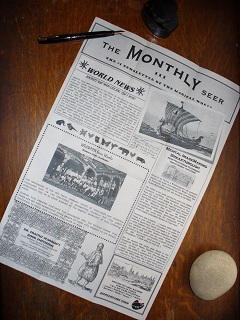
The making for the Summer Wizarding Event continues.  This week we sent out the first newsletter.  We're calling it that but it's really just a fun, faux newspaper aimed at getting people intrigued and excited about things.


Our goal is get everyone involved to imagine this could all actually happen, to suspend their disbelief.  So this newspaper -- we're calling it The Monthly Seer -- has to look authentic.  Our first review came in yesterday: a young reader who will be participating as one of the "new students" pronounced it "really awesome" and commented how much he loved "how old-looking it is" and "really real."

Why it worked:
  • The Seer was printed on heavyweight newsprint paper which was also a little over-sized.  This gave the paper the look and feel of being a real newspaper.
  • We didn't "dumb down" the content.  The stories, ads, and images were written "straight," i.e., as though they referred to actual events, objects, and people.
  • It came in the mail!  The layout of the newspaper included a panel with space for the name and address for recipient, postage, and the return address of the "wizarding school" it was sent from.
Essentially, The Monthly Seer is an elaborate prop for this live role play/theater event. The most successful props are ones that look the most authentic.  Paper props are always a challenge.  For a stage production, the documents only need to look credible from a distance.  

Actual Letter Envelope
Image source

Prop Letter Envelope

For an immersive event, such as a murder mystery game/party or live action role-playing game (aka: LARP), document prop authenticity is vital to maintain the believability of the event, to help the actors all stay in character, and, ultimately, to emotionally and psychologically satisfy the event makers and participants.

Players dressed in character at a LARP event.


Actual Western Union Telegram


Prop Telegram Blank
Real Theater Ticket (1941)
Prop Movie Ticket (used in movie Hancock)

Paper documents are often easier to make than 3-dimensional props,  but getting them to look "really real" can take time.  Some inspiration and resources for making prop documents can be found at these sites.

The Cartographer's Guild - A site for those interested in creating maps. Includes mapmaking tutorials and a library of free symbols, textures, and fonts.

Prop Replicas by Indy Magnoli  - A personal collection of props inspired by the Indiana Jones movies and TV series.

H.P.Lovecraft Historical Society -- These folks have created an extensive paper props collection, some available for free download and some for sale on CD.  NOTE: "Permission is granted for individuals to print copies for their own personal use in role-playing games, but any theatrical, commercial or illegal use is prohibited." 

Propnomicon - [from the site] "Propnomicon focuses on horror and fantasy props of interest to fans of H. P. Lovecraft and players of the "Call of Cthulhu" role playing game. That includes items directly inspired by Lovecraft's writing, DIY information for creating your own works, printable paper props, and source materials related to the 1920's and 30's, the "classic era" of the Cthulhu Mythos."

Eric Hart, assistant props master at the Public Theater in New York City, and a longtime prop maker, has posted some useful links and instructions on using Flickr to locate visual resources for paper props.  That link is here.


Related Posts Plugin for WordPress, Blogger...