Showing posts with label star trek. Show all posts

14 December 2019

Leaving a place, leaving a space


Image from Pixabay

Growing up, as one of 10 children, personal space was at a premium. There were only 3 bedrooms so we--5 girls and 5 boys--typically doubled, tripled, quadrupled, and quintupled up, depending on how many children were in-home at the time. At one point, I shared the largest of the bedrooms with all 4 of my sisters: 2 bunk beds and one single. It didn't look like the above image, but it certainly felt like it.

As the 2nd youngest girl child, though 7th in the lineup, I didn't have much say in which bed was to be mine. For a time I had the bottom bunk and it was heavenly. It meant I had a space--below--to put my stuff. Said stuff was minimal and consisted mostly of a few library books, toys, and shoes. But it was my space and it was a glorious thing to my young self and much treasured.

Image from Pixabay

At some point, and I don't recall why, I got shifted to the upper bunk. There went my private space. Space and privacy are at a premium in a large family. I am sure my siblings felt as aggrieved as I, but one copes. 

Something stuck with me from that experience, though. I developed the ability to make a space my own, no matter what the space configuration, size, or duration and no matter what small amount of furniture I could cobble together from yard sales, Goodwill, or hand-me-overs.[1] An 8x8 foot dorm room in grad school became a haven that I filled with my books, a typewriter, a bike, a guitar, a small (contraband) kitchen setup, and such art as could be tacked to the one open wall without nails. 

 
My first all-my-own apartment was in Washington D.C., in the Turkey Thicket neighborhood of Brookland.[2] It was in a building like the one at the right. It had one bedroom, a skinny bathroom with a rusty tub, a galley kitchen (that was the home of a fair colony of cockroaches), radiators that hissed and clanked, and two wonderful rooms with beat up wooden floors: the small dining and living rooms. There were safety bars on the windows (which didn't stop someone from throwing a kitchen knife through a back porch window one night) and, for a while, a drug dealing duo lived in the flat above. (I recall one evening hearing a knock-down fight up there with lots of yelling. I opened my door to yell at them to keep it down, only to see two of my students fleeing down the stairs, utterly terrified.)

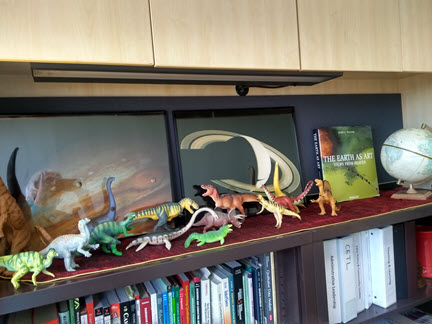
Some 30 years later, some many apartments and two houses later, I retain the make-the-space-good-while-you-have-it mentality. I did this for 2019 where, for most of the year, I worked at a local university. Yesterday was my last day there. I'd been striking the set for a few weeks, bringing home small things I could hand carry: books, pictures, a flock of dinosaur toys. Here are a few pics from my starting weeks to the end.


One of my favorite pieces of "art" was a framed image of Star Trek's Spock, a promotional poster I saved from my D.C. days when I was an assistant manager for the now defunct B. Dalton Bookseller. The poster was for the then, newly published Spock's World, by Diane Duane. [3]


The text below the framed Spock is from Duane's book:

“The spear in the Other's heart
is the spear in your own:
you are he.

There is no other wisdom,
and no other hope for us
but that we grow wise.

-attributed to Surak”


The day before my last day--after the wall art had been removed, the dinos taken home, the books donated or returned to my home library, and the curtains taken down--my colleagues threw me a small goodbye party. I'd never had one before; it was so kind of them. 


There are two pieces of the cake left. We'll have them tonight.

___________________________________

Images
[1] Floor Plan. Image from Pixabay 
[3] Spock's World cover from Abe Books
 

24 August 2011

A Trekkie, I Do Confess It


I am so old school when it comes to matters of Star Trek. I like the original series best, prefer some of the older novels (Diane Duane*, Diane Carey**, Margaret Wander Bonano***, and Janet Kagan****), and thought the reboot movie with two Spocks and the destruction of the entire previous timeline/storyline to be entertaining as a movie but total do-do when it comes to the Start Trek mythology proper.

But while I may be old school, I am always ready to be amused. A Tumblr blog called Spock is Not Impressed takes a single idea - Photoshopping this one image of Mr. Spock - and runs with it.  I've been wanting to learn Photoshop - this may be my motivation for doing so! 


All above images from Spock is Not Impressed

~~~~~~~~~~~~~~~~~~~~~~~~~~~~~~~~~~~~~~~~~~~~~~

* Diane Duane is, to my mind, the best writer of the ST novels.  She crafts her sentences well and has a keen ear for affect and a keen eye in description.  Her first ST novel, The Wounded Sky captures the crisp yet affectionate comaraderie of the Enterprise crew and the wonderment of Space that we 1960s NASA babies still cherish. 


Her more extensive series -- Rihannsu: The Bloodwing Voyages --  takes as its jumping off point a TV episode moment of espionage by Kirk and Spock.  Duane demonstrates her writerly craftiness well: the Romulans ("Rihannsu" as they call themselves) maintain a strong code of honor and nobility similar to that of the Ancient Romans of Earth.  When writing of them, Duane's language shifts into a more stylized, epic sensibility.  I appreciate writers who have that kind of sensitivity to context and character.

** Diane Carey has a fine, intense way with a ST story.  Some are better than others - in my opinion, of course.  She is prolific, that's fer shur, having written 30 ST novels so far.  That may be why the quality varies.  It's hard to maintain a high tone of story, tone, and writerliness at that pace. 

My 2 favorite of hers are Best Destiny (a tale of Kirk as a smart-ass teen who finally figures it out; life, that is) and Final Frontier (where we meet Kirk's father, George, and see where Kirk gets his integrity gene). 


Ms. Carey doesn't appear to have a website - at least I wasn't able to locate one.  A list of her books is at this wikipedia page.

*** Margaret Wander Bonanno's relationship with the world of ST has been a bit rocky due to Paramount's uneven handling of the ST universe with regards to the authors they hire.  "Play the game our way, get published" seems to have been the Paramount mantra for awhile.  But I think she, like Carey, made the mistake of thinking the ST universe was her own.  I stopped reading her stuff when it seemed to me that her non-ST book The Others was an affair with the Vulcan way - the kind of story referred to in the fan-fic biz as a "Mary Sue."

[from Wikipedia]: "A Mary Sue (sometimes just Sue), in literary criticism and particularly in fanfiction, is a fictional character with overly idealized and hackneyed mannerisms, lacking noteworthy flaws, and primarily functioning as a wish-fulfillment fantasy for the author or reader. It is generally accepted as a character whose positive aspects overwhelm their other traits until they become one-dimensional. While the label "Mary Sue" itself originates from a parody of this type of character, most characters labeled "Mary Sues" by readers are not intended by authors as such. Male Mary Sues are often dubbed "Gary Stu", "Larry Stu", "Marty Stu", or similar names."
I don't mean this as a slam on either author.  If I wrote anything for ST it would be totally a Mary Sue novel!  In its idealized form, the ST Universe is a great and desirable place to be.

Her best ST books - again, in my opinion - are Dwellers in the Crucible and Strangers From the Sky.  In both she captures the deep emotional connections that ST characters often share.


 **** The late Janet Kagan wrote one gorgeous ST novel, Uhura's Song.  Its writing is a tad stilted, and Spock is unlike any Spock I saw in the original series, but the story is fully realized and the story both a romp and a reminder of the ST ethos of the IDIC (Infinite Diversity, Infinite Combinations).  What I especially admire is that she snuck in a believable, non-stereotyped gay character (Rushlight to-Vensre the Bard). It's not stated in the book that he is gay, but Kagan noted this in an online comment I read somewhere (an old NaNoWriMo forum, I think).


If you are totally ST geeking at this point, let me refer you to this Wikipedia article which is a list of all the ST novels published to date.  You're welcome!

29 April 2010

Playing By the Rules, or Not

Religion scholar, James P. Carse, wrote a philosophical tract titled Finite and Infinite Games: A Vision of Life as Play and Possibility (© 1987. ISBN: 978-0345341846). Finite games have a set start and end point. The purpose of a finite game is to win, and since a winner can only be identified by the game ending, rules are created to define the end. An infinite game are bit more alpha-omega; there is no set beginning or end.  Play is ongoing; the goal is playing itself.  Humans, it seems, love to play and, Carse suggests, need to play.


Several summers ago at a family reunion, my Beloved Spousal Unit and his sister created a card game. They called it 3 Card Wenceslas. There were no rules, no points, no purpose, except some serious, in-the-moment-silliness.  Watching them create it, spontaneously, and then watching others try to figure out what they were doing was hugely entertaining.

In college I was the T.A. for an English teacher who assigned 'the inventing of a game as one class project. The best one was an elaborate board game named Utopoly by its makers. It was submitted complete with a carefully painted playing board, multi-colored pieces, a detailed set of instructions, and a spinner used to determine the moves. To grade the assignments we (me, the prof, and anyone else we could snag who wasn't in the class) had to play the game.  Grading was based on how well the game played, if the rules of play were understandable, how the game looked, and generally how imaginative and fun it was.  Pretty much everyone got a good grade: being asked to have fun brought out the best in them.


Jim Macdonald, in a posting titled Fairy Chess (A term coined in World War II Britain where "fairy" meant "whimsical.") describes some playful variations to the game of chess.  One version, called Blue Queen, adds a third queen to the board (painted blue so as to distinguish it from the other pieces).  Whoever is currently playing can use the blue queen as she wishes. When the other player begins his turn, the blue queen is then his to maneuver.  A version called Behemoth adds an indestructible piece to the board, the placement of which (and the destruction of which) is created by random throws of an eight-sided and four-sided dice. Alice Chess takes you through the looking glass: two boards are played with a single chess set. 


A version  of chess known to many fans of the original Star Trek series is the three-dimensional game played between Mr. Spock and Captain Kirk.  There are a number of rule variants out there.  Parmen's Page lets you play "Spock's Board" online.  A Trek wiki page describes the original variation and its subsequent history in the Trek universe.  Diane Duane, author of a number of Star Trek novels, posits a 4D version  in My Enemy, My Ally (© 1984, ISBN 0-671-50285-9), where pieces are permitted to travel in and out of play via player-selected time increments on a specially-designed board cube. (D. Joseph Creighton termed this version Hyperchess, which he devised and tested.  The rules can be found here.)


Senet
Image by Keith Schengili-Roberts


It's not uncommon for archaeologists to unearth games of humans long gone.  Senet was an Egyptian game thought to be an earlier version of Backgammon. Written rules have yet to be discovered for it.  Senet was so integral to the culture of that time that it would seem its players felt no need to note them. The folks at KingTutShop have provided info on the board, pieces, posited rules, and game variants here.


Hnefatafl (or King's Table) was a precursor to chess and known in Scandinavia before 400 A. D.  Played on a marked board with set pieces the goal was to reach a corner square with one's King.  The game could play out unevenly, so a game etiquette evolved.  Each game played was actually a pair of games in which players switched sides, each player noting the number of pieces he lost or took from his challenger.  More info and the game rules can be found here.


The late 1960s saw a movement which its founders called "New Games." The founders sought to challenge traditional game philosophies (text quoted from this site):  

Play and physicality were as important to adults as they were to children.


Competition and cooperation should co-exist; but while competition can be important, winning and losing is not.


No one should be left out, eliminated, or unable to play.


Games are living culture, adapted and changed as required.


Play should require no or little equipment.


The rules should be dirt simple and fun.


The guiding philosophy for the New Games movement was: Play Hard. Play Fair. Nobody Hurt. (Note: While out of print, The New Games Book is still available via Amazon as a used book.)


Well, please excuse me. I have to end this post now and go out and play!

Related Posts Plugin for WordPress, Blogger...